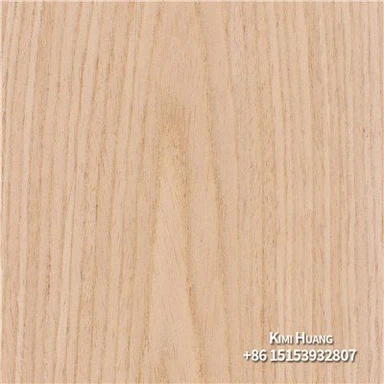

What are the common defects of natural wood veneer?
May 14, 2022
What are the common defects of natural wood veneer? The natural veneer manufacturer told you.
Natural wood veneer has its own characteristics determined by its raw materials, so it is difficult to avoid a variety of defects in the whole process of cutting.
Wormhole
There are round holes in the bark in the form of insects, and important defects are not acceptable.
Mould growth
There are dark brown mildew spots on the wood surface, and important defects are not acceptable.
environmental pollution
If the wood surface is stained with other colors, the white bolt 9\s is acceptable, the beech 25\s environmental pollution with a diameter of more than 5mm is unacceptable, and less than 5mm is acceptable, and the stainless steel polishing with mild environmental pollution can be removed is acceptable.
Color deviation
There is a significant color deviation in the mixed splicing of loose wood veneers. The white bolt 9\is acceptable, and the beech 25\is unacceptable.
Knife pattern
There are strip-shaped or block shaped protrusions and dent patterns on the surface of the veneer. If the relative height of the pattern protrusions or dents exceeds 0.3mm, it is unacceptable. If it is lower than 0.3mm, it is acceptable to divide the positive and negative sides. The convex is the front face and the concave is the back face.
No color essence added to the thread skin
There is milky sealing glue on the 9\and 25\\\.
coincidence
The upper and lower parts of two adjacent wood veneers coincide with each other. The tactility is obviously poor. Important defects are not acceptable.
Small size
If the specification is lower than the standard size, it is an important defect and is not acceptable. Dimensional tolerance 5mm
Uneven thickness
If the thickness of wood veneer is less than 0.3mm and more than 0.6mm, it is an important defect and is not acceptable. Specification thickness: 0.55 ± 0.05mm
The wood skin is lack of flesh, and the surface is uneven. When checking the light, it has light transmittance or flash points. It is not acceptable if it is serious. It is acceptable if it is slightly divided into positive and negative sides. The front face is a raised face, and the back face is a concave edge.
Disintegration
There is a vacancy on the wood veneer surface. The vacancy diameter is less than 1mm, and it is unacceptable if it exceeds 1mm.
Shadow Stripe
There are wavy patterns on the surface, and the touch is uneven. The color deviation between the pattern and the pattern is unacceptable.
Fish scales on the surface of the wood veneer are unacceptable.
Skin clip
The block caused by the diseased surface of the wood veneer, but not rotten, white cork 9\\and beech 25\are acceptable.
Mineral line
There are strip-shaped colored plate root lines on the surface of the wood veneer. White bolt 9\\and beech 25\are acceptable.
There are strip or block gray black objects on the surface of the wood veneer, the white bolt 9\is acceptable, and the beech 25\is not acceptable.
Rot
The wood veneer becomes ill, the material is loose and rotten, and important defects are not accepted.